
Test First, Then Treat: Why Labs Come Before Hormone Therapy
Fatigue, weight gain and low libido have many causes. Here’s why every hormone plan should start with blood work, and why the testing doesn’t stop once treatment begins.
A physician explains what an ultrasound image shows about skin and fat depth, and why that matters for Ultherapy and testosterone pellet placement in the flank, in Hudson, OH and Barboursville, WV.
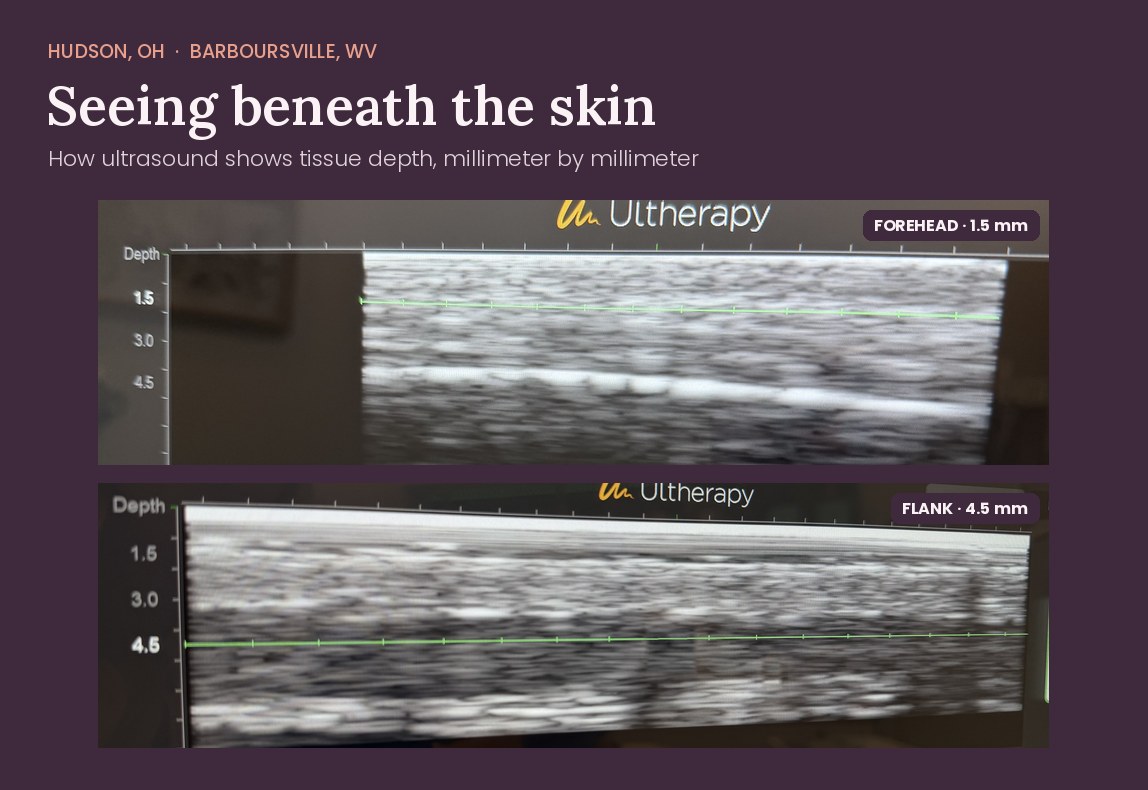
Most of what we do in aesthetic and hormone medicine happens in a space thinner than a coin: the first few millimeters under your skin. You can’t see those layers from the outside, but ultrasound can.
At Serene Med Spa in Hudson, Ohio and Barboursville, West Virginia, our Ultherapy PRIME system has built-in ultrasound imaging called DeepSEE. It shows the skin and the tissue beneath it, up to about 8 mm deep, in real time. Below are two images I captured in our office, and what they teach us about depth.
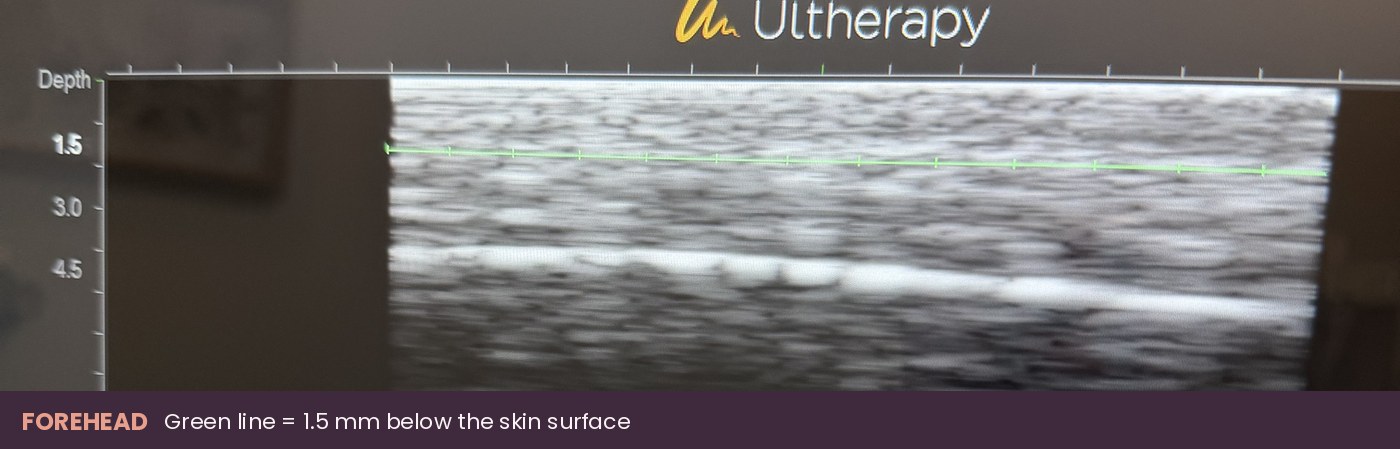
The numbers on the left are depth in millimeters. The green line shows where the 1.5 mm transducer focuses its energy: 1.5 mm below the skin surface.
What sits at 1.5 mm? Published ultrasound measurements put the forehead skin at about 0.8 mm on average, with a thin fat layer beneath it. The frontalis muscle sits deeper, roughly 2 to 3 mm down in the average adult, and it varies from person to person. So the 1.5 mm line is working at the base of the skin and just beneath it, the zone that matters for fine lines, texture and collagen. Deeper transducers (3.0 mm and 4.5 mm) are used to reach the firmer, deeper support layers.
Notice the bright white line lower in the image. Dense structures reflect ultrasound strongly, and on the forehead the bone is only a few millimeters below the surface. This is exactly why we image before we treat: the device instructions say DeepSEE is used to confirm the right treatment depth and avoid bone. Every forehead is different, and the image lets me match the depth to the person in front of me.
In the first published clinical study of Ultherapy on the face and neck, 86% of patients had a significant brow lift at 90 days, with an average lift of about 1.7 mm. That’s a small number with a visible result, which is why millimeters matter.
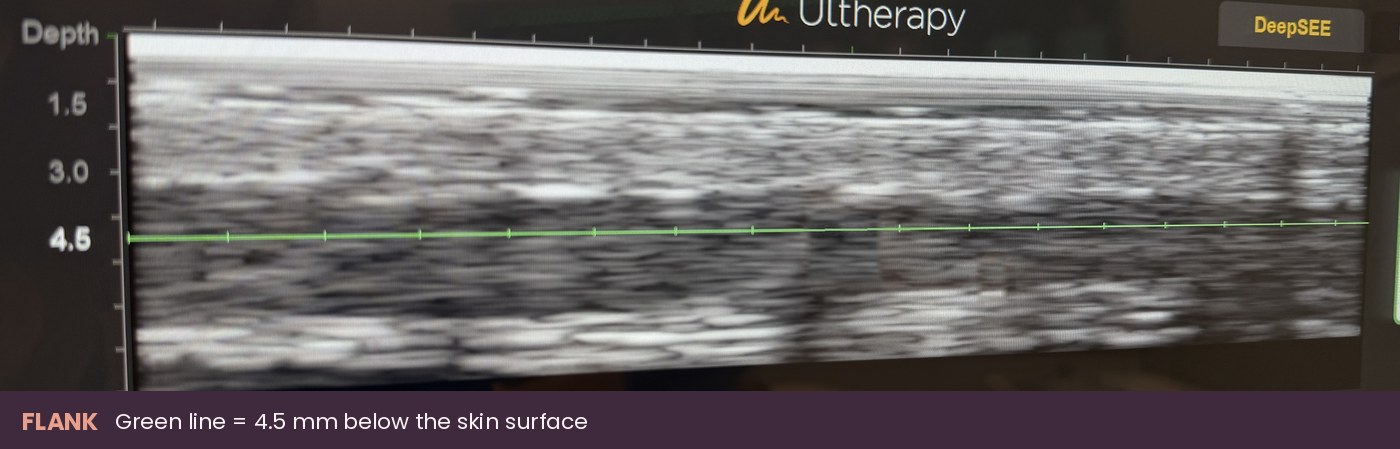
The medical term for “love handles” is the flank, the soft tissue on the side of the waist above the hip. Here the skin is thicker than on the forehead, and beneath it is the subcutaneous fat, the layer where hormone pellets are meant to go. At 4.5 mm we are already below the skin and within that fat layer in this patient.
I use this view before placing testosterone pellets in the flank. It lets me see how thick the skin is, where the fat begins and how the tissue looks, for that specific patient, before I place anything.
Hormone pellets are about the size of a grain of rice. They are placed through a tiny incision using a thin tube called a trocar, and they release hormone slowly over the following months. Common sites are the upper outer buttock (hip), the lower abdomen and the flank.
How often does extrusion happen? It depends a lot on technique and site. Across published studies, rates range from under 1% to about 12%. In one randomized trial, extrusion was more common in the hip than in the abdomen (12% vs 5%), and in another study a modified insertion technique cut extrusion from 7.5% to 0.8%. Technique matters.
Ultrasound isn’t required to place pellets, and I want to be clear about what it can and can’t do:
This approach doesn’t depend on the pellet brand. Whichever pellet is used, the same principle holds: the right layer, placed with good technique.
Learn more on our hormone optimization page or our Ultherapy page.
In the subcutaneous fat, usually in the upper outer buttock, the lower abdomen or the flank (love handle area), through a tiny incision.
Yes. It’s called extrusion. Published rates range from under 1% to about 12%, and they depend on the site and technique. Placing pellets in the fat layer, away from the incision, is key.
No. It is an extra check we use to see the skin and upper fat layer before placement. No published study has yet shown that ultrasound guidance lowers pellet complications.
No. Whatever the brand, pellets are placed in subcutaneous fat.
No. At 1.5 mm we are at the base of the skin. The forehead’s muscle layer, the frontalis, usually sits deeper, around 2 to 3 mm, and varies by person. That’s why we image before treating.
Serene Med Spa offers physician-led hormone optimization in Hudson, OH, serving Stow, Twinsburg, Aurora, Streetsboro, Macedonia, Solon, Kent, Cuyahoga Falls and Akron, and in Barboursville, WV, serving Huntington, Milton, Ona, Hurricane, Culloden, Lesage, Ashland, KY and Proctorville and Chesapeake, OH.
Visit us at 50 W Streetsboro St, Suite 2, Hudson, OH · (330) 460-5915, or 1 Chateau Grove Ln, Barboursville, WV · (304) 520-0461.
References: Merz Aesthetics. Ultherapy PRIME Instructions for Use. 2024. · Fabi SG. Noninvasive skin tightening: focus on new ultrasound techniques. Clin Cosmet Investig Dermatol. 2015. · Alam M, et al. Ultrasound tightening of facial and neck skin: a rater-blinded prospective cohort study. J Am Acad Dermatol. 2010. · Zhuang et al. Analysis of the Factors Influencing Forehead Soft-Tissue Thickness: An Ultrasound Study. Aesthet Surg J Open Forum. 2025. · Endo Pharmaceuticals. Testopel Implantation Guide. · Kelleher S, et al. Influence of implantation site and track geometry on the extrusion rate and pharmacology of testosterone implants. Clin Endocrinol. 2001. · Conners W, et al. Outcomes with the “V” implantation technique vs. standard technique for testosterone pellet therapy. J Sex Med. 2011. · Gibney MA, et al. Skin and subcutaneous adipose layer thickness in adults with diabetes at sites used for insulin injections. Curr Med Res Opin. 2010. · Mastey N, et al. US referral center experience removing nonpalpable and difficult contraceptive implants with in-office ultrasonography. Contraception. 2021. · National Academies of Sciences, Engineering, and Medicine. The Clinical Utility of Compounded Bioidentical Hormone Therapy. 2020.
This article is for general information only and is not medical advice. Ultrasound images are from Serene Med Spa and are shown for education; no patient-identifying information is included. Ultherapy is FDA-cleared to lift the brow and the skin under the chin and on the neck, and to improve lines and wrinkles on the décolleté. Testopel is an FDA-approved testosterone pellet; many other hormone pellets are compounded preparations that are not FDA-approved. Hormone therapy is provided only after consultation, lab testing and evaluation by a licensed provider. Individual results vary.

Fatigue, weight gain and low libido have many causes. Here’s why every hormone plan should start with blood work, and why the testing doesn’t stop once treatment begins.

Hot flashes, night sweats, brain fog, weight gain and low libido are common, but you don’t have to just live with them. Here’s what’s happening and the options that help.

Tired, foggy or just not yourself? A physician walks through what a wellness lab panel checks, test by test, and why the trend in your numbers matters as much as any single result.