Is 25% Body Fat Healthy? What It Means for Men and Women
At 25 percent, a quarter of your weight is fat. For many women that’s a healthy number. For men it’s the point where health risks start to climb.
Does muscle weigh more than fat? No, but it takes up far less space. Why the scale can stall while you get healthier, and how a free InBody scan shows what your weight is made of.

Your bathroom scale gives you one number: everything you weigh, all at once. It can’t tell you how much of that is muscle, how much is fat, and how much is water and bone. That’s why two people with the same height and weight can look, feel and function completely differently.
If you’ve been working hard and the scale won’t budge, this post is for you.
No. A pound is a pound. What’s different is how much space that pound takes up.
Muscle is denser than fat, roughly 1.1 grams per cubic centimeter versus about 0.9 for fat. In everyday terms, 5 pounds of muscle is about the size of a paperback book, while 5 pounds of fat is closer to the size of a small football.
| Muscle | Fat | |
|---|---|---|
| Density | About 1.1 g/cm³ | About 0.9 g/cm³ |
| Space it takes up | Compact | Bulky |
| How it looks | Firm, defined | Soft, less defined |
| Calories it burns at rest | Several times more per pound | Much less |
| How it responds | Grows with strength training | Shrinks with a modest calorie deficit |
So if you lose 10 pounds of fat and gain 10 pounds of muscle, the scale says nothing changed. Your clothes, your energy and your health markers say otherwise.
When you start strength training, a small bump on the scale is common, and it’s usually a good sign. A few things are happening at once:
The result can look like a plateau on the scale while your body is actually losing fat and gaining muscle at the same time. That’s called body recomposition, and it’s exactly what you want.
Body composition is the mix of muscle, fat, water and bone that makes up your weight. For your health, that mix tells you far more than the total.
Large studies back this up. People who are fit but carry extra weight tend to do better over time than people at a “normal” weight who are out of shape. More muscle is also linked to lower heart disease risk, even at a higher body weight.
Building muscle can improve these, even if the scale barely moves:
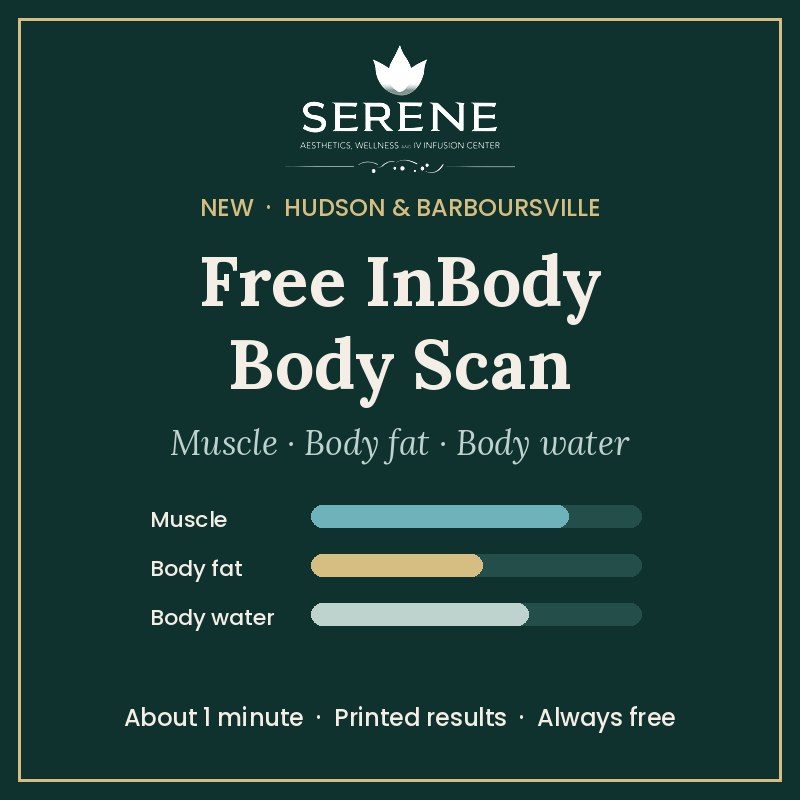
A regular scale can’t tell muscle from fat. Our InBody 580 can. It sends a very small, painless electrical signal through your body and measures how it travels through muscle, fat and water.
The scan is free at both our Hudson and Barboursville offices, as often as you like, with no purchase needed. It takes about 1 minute, and you leave with a printout that includes:
For the most useful results: scan at about the same time of day each visit, before a workout, before a big meal, and after using the restroom.
The goal isn’t a lower number on the scale. It’s more muscle and less fat. Here’s what works:
Related reading: Why the Scale Lies: Tracking Body Composition Instead of Weight · Lean Body Mass vs. Muscle Mass
Want to know what your weight is really made of? Book a free InBody scan at our Hudson or Barboursville office. If you’d like help with what comes next, our medical team can walk you through your results and build a plan around them, including our medical weight loss and wellness programs.
The InBody scan isn’t for anyone with a pacemaker or other implanted electronic device, or who is pregnant. This article is for general education and isn’t a substitute for advice from your own healthcare provider.

At 25 percent, a quarter of your weight is fat. For many women that’s a healthy number. For men it’s the point where health risks start to climb.
A scale rolls fat, muscle and water into one number and lets it set your mood. Body composition breaks that number into its parts, and the parts are what actually change when a plan is working.
A GLP-1 medication changes how much you eat. What you eat, how you move and how you care for your skin decide how you look and feel at the end.